Loading this country
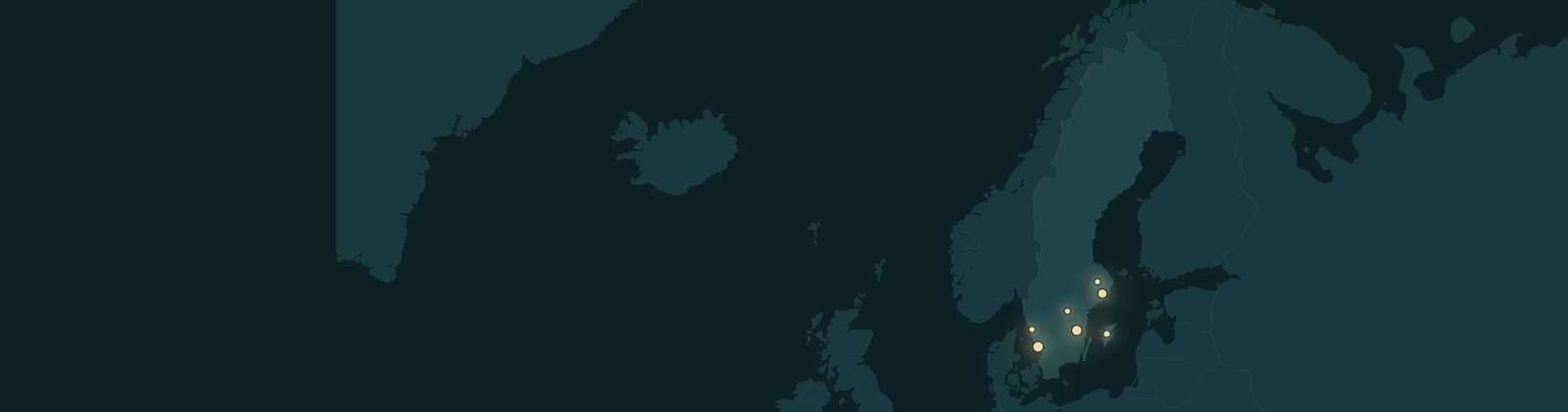 Falkenberg59 beersStockholm15 beers
Swedish beer
654 beers from 13 towns
Swedish law sorts beer by strength: folköl, from 2.25% up to 3.5% ABV, can be sold in food shops, while stronger starköl reaches retail customers through the state monopoly, Systembolaget. Many international brands therefore make a separate 3.5% version for the supermarket. Systembolaget shuts on Sundays and sells cans singly and unchilled, and a trial running until 2031 lets small producers sell limited amounts to visitors on site.
Where to start
Carnegie Porter
A survivor of the British porter trade in the Baltic, still brewed in Sweden long after the style collapsed at home.
Omnipollo Nebuchadnezzar
From a Stockholm partnership between a brewer and an artist that owned no brewery for years and made the labels part of the…
Beer in Sweden
Sweden's oldest surviving brand is a beer, and it came out of a Scottish trading house in Gothenburg. David Carnegie Jr of D. Carnegie & Co bought a sugar and porter works in the city at a bankruptcy auction. Under Oscar Ekman, who took charge in 1841, porter output quadrupled. Carnegie Porter, registered in 1885 and now owned by Carlsberg, is a Baltic porter.
When brewers formed their association in 1885, Sweden had more than 500 breweries. Statistics Sweden traces the collapse that followed to a 1914 ban on selling strong beer and the motbok, introduced in 1917: the start of the so-called bryggeridöden, the death of the breweries. In 1977 the ban on mellanöl, literally "middle beer", added to the fall, a parliamentary committee reported.
The recovery came late and fast. Statistics Sweden counted 16 breweries in 1993, 42 in 2010 and 392 at the end of 2017, when the average brewery had fewer than five employees. Lager still dominates, but the trade body says pale lager now sits beside ale, stout and wheat beer. Omnipollo calls its Nebuchadnezzar a home-brew recipe scaled up: an imperial IPA of 8.5%, brewed in Sweden, Canada and the United States.
Sources: Carnegie: Our history, Carlsberg Sverige: Carnegie Porter, Sveriges Bryggerier (Swedish Brewers' Association): Om oss, Sveriges Bryggerier: Öl, Statistics Sweden (SCB): Svensk bryggeriboom förändrar branschen, Sveriges riksdag: Näringsutskottets betänkande 1982/83:40, Omnipollo: Nebuchadnezzar.
All 654 Swedish beerspage 1 of 11
Carnegie Porter
Omnipollo Nebuchadnezzar
11 Month Single Select Barrel Buffalo Trace Experimental Rye Imperial Stout
18 Decillion
7 Sons
8-Tuple Dry Hopped Fatamorgana
A Decade of Pastry - Noa Anniversary
AON Pecan Mud Cake Stout Glenmorangie 10 y.o Barrel Select BA
Abdia
Abjad
Abrahadabra
Ad Astra
Adorcism
Agamemnon
Agamemnon Bourbon
Agamemnon Maple Blueberry
Agamemnon Monster Shake
Alazar
Albedo
All Wise Peanut Banana Imperial Stout
All the Coconut
All the Vanilla
Amaretto Sour
Amun
Amurga
Amy 100 Day Pilsner
Amy French Oak
Anadrome Mango Cheesecake Sour
Anadrome Passionfruit Cheesecake Sour
Anagram Blueberry Cheesecake Stout
Anagram Blueberry Cheesecake Stout (2021)
Anagram Blueberry Hazelnut Coffee Cheesecake Stout 2022
Andromeda
Andromeda 2.0
Aniara
Anima
Another Hoppy Ale
Another Marshmallow Ale
Antropomorf
Aon Bourbon Bacon Burger
Aon Bourbon Hazelnut Fudge
Aon Bourbon S'Mores Shake
Aon Cocoalmond Coffee Imperial Stout
Aon High Altitude Dry & Wet Fermented Gesha Village Estate Coffee
Aon Marzipan Float
Apkallu
Apollo Cherry Pulp Sour
Argus
Arton56
Arton56 Glutenfri
Arzachel
Avgrund
BAHA
BRON IPA
BRON Pale Ale
Balaton Strata IPA
Banana Toffee Chocolate
Barrel Aged Banana Cookie Kooks
Barrel Aged Eton Mess Brush
Barrel Aged Kokostopp
Swedish beer styles
- Imperial Stout102
- Gose51
- Double IPA42
- Sour beer35
- American IPA34
- American Pale Ale29
- Pale Lager27
- New England IPA21
- Pilsner18
- Milkshake India Pale Ale14
- Porter14
- Pale Ale9
- New England Pale Ale7
- Fruit beer6
- Saison6
- Session India Pale Ale6
- Triple India Pale Ale6
- India Pale Ale5
- Stout5
- Munich Helles4
- Vienna Lager4
- Old Ale3
- Wheat Beer3
- Belgian Ale1
- Black India Pale Ale1
- Doppelbock1
- India Pale Lager1
- Winter warmer1
Breweries7 of 7
| Brewery | Town | Founded | Beers |
|---|---|---|---|
| Dugges Bryggeri | BK Häcken FF | 9 | |
| Omnipollo | Several | 9 | |
| Carlsberg Sverige AB | Falkenberg | 2001 | 2 |
| Vivungs Bryggeri | Romakloster | 2 | |
| Carlsberg Sverige | Gothenburg | 2001 | 1 |
| Nordsj Grdsbryggeri | Motala | 1 | |
| Slottskllans Bryggeri | Uppsala | 1 |
On the recordcounted from 654 beers
Strength
The median is 5.0% ABV. Half of them fall between 4.5% and 5.8%. Measured on 23 of the 654; the rest carry no strength.
- Strongest Banana Toffee Chocolate11.5%
- Weakest Bianca Non-Alcoholic Pineapple Sour0.3%
The record here
- Breweries7
- Towns13
- Styles28
Oldest brewery with a sourced year: Carlsberg Sverige, 2001.
These are facts about this record, not about the world. The atlas is only as deep as its sources: 74% of everything it holds is American or Dutch, because that is what the bulk import reached. The styles most often recorded in Sweden are not necessarily the ones most often brewed there.
Explore the towns
Sweden8 towns
Towns as a table8
| Town | Beers |
|---|---|
| Falkenberg | 59 |
| Vimmerby | 37 |
| Stockholm | 15 |
| Romakloster | 2 |
| Gothenburg | 1 |
| Motala | 1 |
| Penryn | 1 |
| Uppsala | 1 |